Journals
- P. Maurya, A. Hazra, and A. Kalita, “Unleashing the Potential of Industrial IoT and Industry 5.0" in IEEE Engineering Management Review , 2025. (Accepted) Xplore
- P. Joshi, A. Kalita, and M. Gurusamy, “Reliable and Efficient Data Collection in UAV-based IoT Networks" in IEEE Communications Surveys and Tutorials, I.F: 46.7, vol:28, pp: 2531 - 2571 2025. Xplore
- A. Hazra, A. Kalita, M. Gurusamy, and D. Sah, “Potential of Zero-Touch Network Management in Industry 5.0: A Future Prospect" in IEEE Internet Computing , I.F: 3.7, vol: 28, no: 6, pp: 45 - 52, 2024. Xplore
- A. Hazra, P. Maurya, A. Kalita, S. Deb, M. Gurusamy, and V. G. Menon, “Cognitive Computing and Machine Intelligence in Fog-Cloud Infrastructure for Industry 5.0" in IEEE Consumer Electronics Magazine, I.F: 4.5, 2024.
PDF Abstract BibTeX XploreIn the context of Industry 5.0, the integration of cognitive computing and machine intelligence can significantly transform the industrial manufacturing processes. In the transition of Industry 4.0 to Industry 5.0, along with cognitive computing and machine intelligence, the integration of fog-cloud can further revolutionise future industries. This article briefly discusses the complex relationship among these technologies, with a specific focus on consumer devices. Subsequently, we design a decision-making system based on Deep Reinforcement Learning (DRL) within industrial environments. Finally, various issues and possible solutions in the context of cognitive computing and machine intelligence in Industry 5.0 are discussed.
@ARTICLE{10504655, author ={A. Hazra, P. Maurya, A. Kalita, S. Deb, M. Gurusamy, and V. G. Menon,}, journal={IEEE Consumer Electronics Magazine}, title={{Cognitive Computing and Machine Intelligence in Fog-Cloud Infrastructure for Industry 5.0}}, year={2024}, volume={}, number={}, pages={1-6}, doi={10.1109/MCE.2024.3405109}}} - A. Kalita, and M. Gurusamy, “On-the-Fly Autonomous Slot Allocation in 6TiSCH-based Industrial IoT Networks” in IEEE Transactions on Industrial Informatics, I.F: 12.3, vol: 20, no: 7, pp: 9365 - 9374, 2024.
PDF Abstract BibTeX XploreThe IPv6 over time-slotted channel hopping mode of IEEE 802.15.4e (6TiSCH) wireless protocol stack is released to offer high-throughput, low and bounded latency, energy efficient, and reliable communication in industrial Internet of Things (IoT). However, scheduling communication cell among the nodes for exchanging sensory data is not trivial in 6TiSCH networks when the network traffic is highly dynamic and unpredictable. The existing autonomous scheduling schemes suffer from static allocation, high end-to-end latency, and high energy consumption. To address the abovementioned problems, in this work, we propose on-the-fly autonomous slot allocation (OASA) scheme to schedule slots for adaptive traffic in 6TiSCH networks autonomously and immediately. OASA also enables a low radio-duty-cycle of the nodes when network traffic is less, which is not considered by any existing adaptive autonomous schedulers. To validate the effectiveness of OASA, we implemented it on Contiki-NG and performed testbed experiments on FIT IoT-LAB. The testbed experiment results demonstrate the effectiveness of OASA in terms of latency, packet delivery ratio, and energy consumption compared to the existing autonomous scheduling schemes.
@ARTICLE{10504655, author ={Kalita, Alakesh and Gurusamy, Mohan}, journal={IEEE Transactions on Industrial Informatics}, title={{On-the-Fly Autonomous Slot Allocation in 6TiSCH-Based Industrial IoT Networks}}, year={2024}, volume={20}, number={7}, pages={ 9365 - 9374}, doi={10.1109/TII.2024.3385117}} - A. Hazra, A. Kalita, and M. Gurusamy, “Distributed Service Provisioning with Collaboration of Edge and Cloud in Industry 5.0” in IEEE Internet of Things Journal, I.F: 10.6, vol. 11, no. 12, pp. 21885-21894, 2024.
PDF Abstract BibTeX XploreIndustry 5.0 aims to elevate industrial operations, businesses, and revolution to new heights by promoting sustainable, resilient, and human-centric practices. The popularity of Industry 5.0 is reflected in the increasing demand for real-time and near-edge processing in most latency-critical Industrial Internet of Things (IIoT) applications. However, designing an efficient task priority assignment strategy and accordingly executing tasks within the stipulated deadline is complex and challenging. Therefore, in this work, we design a novel Multi-device Edge Service Provisioning (MESP) framework for optimizing delay in Industry 5.0. At first, the MESP strategy classifies edge executable tasks using multi-nomial probability theory. Then, we prove that multi-device service demand at the edge devices is an NP-Hard problem, which requires approximate algorithms for finding near-optimal solutions. To follow this, we propose a game-theoretic approach where multiple IIoT devices request various services simultaneously while maximizing their mutual satisfaction. We also examine the structural property of the proposed game and show how this property helps in achieving the equilibrium point of the proposed game with finite improvement steps. Experimental analysis shows that MESP reduces computational overhead and end-to-end execution delay by 20-30% compared to standard algorithms.
@ARTICLE{10477502, author ={Hazra, Abhishek and Kalita, Alakesh and Gurusamy, Mohan}, journal={IEEE Internet of Things Journal}, title={{Distributed Service Provisioning With Collaboration of Edge and Cloud in Industry 5.0}}, year={2024}, volume={}, number={}, pages={1-1}, doi={10.1109/JIOT.2024.3380193}} - A. Hazra, A. Kalita, and M. Gurusamy, “Meeting the Requirements of Internet of Things: The Promise of Edge Computing” in IEEE Internet of Things Journal, I.F: 10.6, vol. 11, no. 5, pp. 7474 - 7498, 2024.
PDF Abstract BibTeX XploreOver the last few decades, Internet of Things (IoT) has become the spotlight area of research within the Industries and Academics. Primarily, IoT devices are characterized by small and nonscalable resources, including low processing capabilities, less internal memory, and short battery life. However, IoT applications demand extensive storage and faster response to ensure seamless and interoperable communication. Hence, Edge Computing and data/task offloading among the edge or cloud servers become promising, while also posing critical research challenges for edge-enabled large-scale IoT ecosystems. Several research activities have addressed the difficulties of determining an efficient and scalable data offloading strategy utilizing edge and cloud computing-supported technologies. This article focuses on the state-of-the-art edge IoT data offloading techniques, and optimization models in the heterogeneous IoT environment. We examine how edge and cloud-supported technologies can handle delay-sensitive IoT applications efficiently. Moreover, we introduce an IoT-based healthcare use case scenario to explain edge data execution and resource provisioning in IoT networks. Finally, we discuss several challenging issues and possible solutions to establish interoperable communication and computation for IoT applications.
@ARTICLE{10342693, author ={Hazra, Abhishek and Kalita, Alakesh and Gurusamy, Mohan}, journal={IEEE Internet of Things Journal}, title={Meeting the Requirements of Internet of Things: The Promise of Edge Computing}, year={2024}, volume={11}, number={5}, pages={7474-7498}, doi={10.1109/JIOT.2023.3339492}} - A. Kalita, A. Hazra and M. Gurusamy, “Parrando’s Paradox based Enhanced Beacon Transmission in 6TiSCH Networks” in IEEE Networking Letters, vol. 5, no. 4, pp. 204-207, 2023.
PDF Abstract BibTeX XploreThe standardized 6TiSCH network offers high throughput, reliable, delay-bounded, and energy-efficient communication in Internet of Things networks. For 6TiSCH bootstrapping, 6TiSCH minimal configuration standard has been released, which uses a fixed transmission rate of Enhanced Beacon (EB) control frame throughout the network’s lifetime. However, our theoretical analysis shows both high and low EB rates affect new joining nodes’ synchronization time and energy consumption. To address this, we propose Parrondo’s Paradox-based EB Transmission (PPET) scheme, which allows already joined nodes to transmit their EB frames probabilistically. Both theoretical and experimental results show the performance improvement by PPET compared to benchmark schemes.
@ARTICLE{10121813, author ={Kalita, Alakesh and Hazra, Abhishek and Gurusamy, Mohan}, journal={IEEE Networking Letters}, title={Parrondo’s Paradox-Based Enhanced Beacon Transmission in 6TiSCH Networks}, year={2023}, volume={5}, number={4}, pages={204-207}, doi={10.1109/LNET.2023.3274308}} - A. Kalita, M. Gurusamy, and M. Khatua, “A Gaming and Trust Model based Counter Measure for DIS Attack on 6TiSCH IoT Networks” in IEEE Internet of Things Journal, IF-10.238, vol. 10, no. 11, pp. 9727 - 9737, 2023.
PDF Abstract BibTeX XploreThe 6TiSCH communication architecture provides delay-bounded packet delivery, energy efficient, and reliable data-delivering communication in mission-critical Internet of Things (IoT) applications. It uses IETF’s 6TiSCH minimal configuration (6TiSCH-MC) standard for resource allocation during network formation and routing using a routing protocol for low power and lossy network (RPL) as routing protocol. In RPL, the DODAG information solicitation (DIS) control packet is used to solicit routing information from the existing networks. However, it is observed that malicious transmission of this DIS packet can severely affect the 6TiSCH networks in terms of nodes’ network joining time and energy consumption. Therefore, designing countermeasures of DIS attack in 6TiSCH network has become critically important. Additionally, the existing works neither considered all the possible parameters together for detecting DIS attack nor energy efficient, and create control packet overhead. In this work, we model noncooperative gaming to determine the optimal probability of responding to a DIS packet. Subsequently, we design a trust model to detect malicious DIS transmission in 6TiSCH networks. Finally, we merge both the proposed gaming model and trust model to propose a scheme—gaming and trust-based countermeasure (GTCM) to reduce the effect of DIS attack in 6TiSCH networks. We implement the GTCM on Contiki-NG and validate it using open source FIT IoT-LAB testbed. Our experimental testbed results show that GTCM reduces the effect of DIS attack in terms of pledges’ (new nodes) joining time and energy consumption significantly.
@ARTICLE{10007639, author={Kalita, Alakesh and Gurusamy, Mohan and Khatua, Manas}, journal={IEEE Internet of Things Journal}, title={{A Gaming and Trust-Model-Based Countermeasure for DIS Attack on 6TiSCH IoT Networks}}, year={2023}, volume={10}, number={11}, pages={9727-9737}, doi={10.1109/JIOT.2023.3234300}} - A. Kalita and M. Khatua, “Time-Variant RGB Model for Minimal Cell Allocation and Scheduling in 6TiSCH Networks” in IEEE Transactions on Mobile Computing, IF=7.9, vol. 23, no. 2, pp. 1803 - 1814, 2023.
PDF Abstract BibTeX XploreIEEE has standardized the 802.15.4e Time Slotted Channel Hopping (TSCH) mode to provide stringent latency, higher reliability, and low duty-cycle in various Internet of Things (IoT) applications. TSCH eliminates interference and multi-path fading on channels, but its channel hopping feature severely affects the 6TiSCH (IPv6 over IEEE 802.15.4e TSCH mode) network formation. Further, 6TiSCH Minimal Configuration standard does not provide sufficient bandwidth (i.e., minimal cell) for quick transmission of control packets required by the new nodes (i.e., pledges) during their network association. Many works have been proposed on 6TiSCH network formation as it has high impact on network performance and lifetime. However, the existing works either did not use all the available physical channels while allocating minimal cell(s) or are not stable with topology changes. Therefore, this work proposes a T ime-Variant RGB (TRGB) model for minimal cell allocation and scheduling, which results in faster association of pledges and maintains network stability. We evaluate the TRGB using Markov Chain model and also on a real 60-node testbed in FIT IoT-LAB. Testbed results show that TRGB achieves 51% and 23% improvement over the state-of-the-art scheme in terms of joining time and energy consumption, respectively, while maintaining stability of the network.
@ARTICLE{10032650, author={Kalita, Alakesh and Khatua, Manas}, journal={IEEE Transactions on Mobile Computing}, title={{Time-Variant RGB Model for Minimal Cell Allocation and Scheduling in 6TiSCH Networks}}, year={2024}, volume={23}, number={2}, pages={1803-1814}, doi={10.1109/TMC.2023.3241021}} - A. Kalita and M. Khatua, “6TiSCH – IPv6 Enabled Open Stack IoT Network Formation: A Review” in ACM Transactions on Internet of Things, IF=2.7, vol. 3, no. 3, pp. 1-35, 2022.
PDF Abstract BibTeX ACM Lib.The IPv6 over IEEE 802.15.4e TSCH mode (6TiSCH) network is intended to provide reliable and delay bounded communication in multi-hop and scalable Industrial Internet of Things (IIoT). The IEEE 802.15.4e Time Slotted Channel Hopping (TSCH) link layer protocol allows the nodes to change their physical channel after each transmission to eliminate interference and multi-path fading on the channels. However, due to this feature, new nodes (aka pledges) take more time to join the 6TiSCH network, resulting in significant energy consumption and inefficient data transmission, which makes the communication unreliable. Therefore, the formation of 6TiSCH network has gained immense interest among the researchers. To date, numerous solutions have been offered by various researchers in order to speed up the formation of 6TiSCH networks. This article briefly discusses about the 6TiSCH network and its formation process, followed by a detailed survey on the works that considered 6TiSCH network formation. We also perform theoretical analysis and real testbed experiments for a better understanding of the existing works related to 6TiSCH network formation. This article is concluded after summarizing the research challenges in 6TiSCH network formation and providing a few open issues in this domain of work.
@article{10.1145/3536166, author={Kalita, Alakesh and Khatua, Manas}, title={{6TiSCH – IPv6 Enabled Open Stack IoT Network Formation: A Review}}, year={2022}, issue_date={August 2022}, publisher={Association for Computing Machinery}, address={New York, NY, USA}, volume={3}, number={3}, url={https://doi.org/10.1145/3536166}, doi={10.1145/3536166}, journal={ACM Trans. Internet Things}, month={jul}, articleno={24}, numpages={36}} - A. Kalita, A. Brighente, M. Khatua, M. Conti, “Effect of DIS Attack in 6TiSCH Network Formation” in IEEE Communication Letters, IF=3.55, vol. 26, no. 5, pp. 1190-1193, 2022.
PDF Abstract BibTeX XploreThe 6TiSCH standard provides minimum latency and reliability in mission-critical IoT applications. To optimize resource allocation during 6TiSCH network formation, IETF released the 6TiSCH minimal configuration (6TiSCH-MC) standard. 6TiSCH-MC considered IETF’s IPv6 Routing Protocol for Low power and Lossy network (RPL) as a routing protocol for both upward and downward routing. In RPL, new joining nodes or joined nodes transmit DODAG Information Solicitation (DIS) requests to get routing information from the network. However, we observe that malicious node(s) can severely affect 6TiSCH networks by sending multiple DIS requests. In this letter, we show and experimentally evaluate on real devices the impact of the DIS attack during 6TiSCH networks formation. We show that the attacker does not need expensive resources or access to the network’s sensitive information to execute the DIS attack . Our testbed experiments show that the DIS attack significantly degrades the nodes’ joining time and energy consumption, increasing them by 34% and 16%, respectively, compared to normal functioning during 6TiSCH network formation.
@ARTICLE{9724242, author={Kalita, Alakesh and Brighente, Alessandro and Khatua, Manas and Conti, Mauro}, journal={IEEE Communications Letters}, title={{Effect of DIS Attack on 6TiSCH Network Formation}}, year={2022}, volume={26}, number={5}, pages={1190-1193}, doi={10.1109/LCOMM.2022.3155992}} - A. Kalita and M. Khatua, “A Non-cooperative Gaming Approach for Control Packet Transmission in 6TiSCH Network” in IEEE Internet of Things Journal, IF=10.238, IF-11.7, vol. 9, no. 5, pp. 3954-3961, 2022.
PDF Abstract BibTeX XploreThe 6TiSCH communication architecture is widely used in Industrial Internet of Things (IIoT) to provide reliable, delay-bounded, and energy-efficient communication in multihop scenarios. However, the channel hopping feature and the resource allocation strategy of 6TiSCH minimal configuration (6TiSCH-MC) standard negatively impact the 6TiSCH network by increasing network formation time. 6TiSCH-MC allows only one cell (known as minimal cell) per slotframe to transmit control packets. When the number of joined nodes increases in the network, the formation time also increases because of the increasing congestion in the minimal cell. Furthermore, the existing works did not study the effect of transmission rates of all control packets together during 6TiSCH network formation. Therefore, in this work, a noncooperative game is formulated, for optimal transmission of control packets by the joined nodes. The obtained solution of the proposed game, using the Lagrange multiplier and Karush–Kuhn–Tucker (KKT) conditions, is used in the proposed congestion control scheme—game theory-based congestion control (GTCC). GTCC calculates the slotframe window (SW) size for every node to control the congestion in minimal cell without any signaling overhead. GTCC is validated using the analytical model as well as the FIT IoT-LAB testbed. The findings of both the analytical and testbed experiments show that GTCC significantly reduces the joining time and energy consumption of new nodes (i.e., pledges) as compared to previous benchmark schemes.
@ARTICLE{9504426, author={Kalita, Alakesh and Khatua, Manas}, journal={IEEE Internet of Things Journal}, title={{A Noncooperative Gaming Approach for Control Packet Transmission in 6TiSCH Network}}, year={2022}, volume={9}, number={5}, pages={3954-3961}, doi={10.1109/JIOT.2021.3101941}} - A. Kalita and M. Khatua, “Adaptive Control Packet Broadcasting Scheme for Faster 6TiSCH Network Bootstrapping” in IEEE Internet of Things Journal, IF=10.238, vol. 8, no. 24, pp. 17395–17402, 2021.
PDF Abstract BibTeX XploreThe IPv6 over the TSCH mode of IEEE 802.15.4e (6TiSCH) Working Group released 6TiSCH minimal configuration (6TiSCH-MC) standard for 6TiSCH network bootstrapping. 6TiSCH-MC allocates only one shared cell per slotframe, known as a minimal cell, to transmit all types of control packets. Our Markov Chain-based probabilistic analysis reveals that few network parameters have a high impact on the performance of 6TiSCH network formation due to increasing congestion in the minimal cell with the increased number of nodes. This work aims to improve the 6TiSCH network formation process by reducing congestion in the minimal cell. For this, the Trickle algorithm, which is used for controlling the rate of routing information-carrying packet transmission is modified so that sufficient routing information can be provided without congesting the minimal cell. To reduce the congestion further, a slotframe window (SW)-based adaptive scheme is proposed by which nodes are restricted to transmit their control packets frequently. The proposed dynamic Trickle algorithm and SW-based scheme are implemented on Contiki-NG and evaluated using FIT IoT-LAB testbed. The experimental results show that both the proposed schemes together improve the joining time and energy consumption of the pledges compared to the state-of-the-art schemes. Additionally, both the proposed schemes provide fair control packet transmission opportunities among the nodes in a network.
@ARTICLE{9432409, author={Kalita, Alakesh and Khatua, Manas}, journal={IEEE Internet of Things Journal}, title={{Adaptive Control Packet Broadcasting Scheme for Faster 6TiSCH Network Bootstrapping}}, year={2021}, volume={8}, number={24}, pages={17395-17402}, doi={10.1109/JIOT.2021.3080735}} - A. Kalita and M. Khatua, “Autonomous Allocation and Scheduling of Minimal Cell in 6TiSCH Network” in IEEE Internet of Things Journal, IF=10.238, vol. 8, no. 15, pp. 12242-12250, 2021.
PDF Abstract BibTeX Xplore6TiSCH standardization helps the Industrial Internet of Things (IIoT) to achieve reliable and timed data delivery. It also deals with minimal resource allocation during network formation. However, faster network formation using minimum resources remains an active research issue. 6TiSCH minimal configuration standard (6TiSCH-MC) recommends to use only one cell per slotframe known as the minimal cell for all the nodes to transmit their network bootstrapping traffic. It is observed that, including 6TiSCH-MC, the existing schemes did not use all the available cells, and so, all the physical channels at the timeslot where this minimal cell resides, i.e., at timeslot zero. It results in underutilization of channel resources, and thus, higher network formation time. To leverage the available cells at timeslot zero of each slotframe, and thus to improve the network formation performance, an autonomous allocation and scheduling of minimal cell (TACTILE) is proposed. The main challenge is to utilize the available cells at timeslot zero as there is a minimal cell already scheduled for network bootstrapping. To address this issue, TACTILE distributes the location of the minimal cell as per nodes' EUI64 addresses along the different physical channels followed by scheduling them intelligently to avoid de-synchronization among nodes. Combined with Markov chain-based theoretical analysis, evaluation of TACTILE is done on the FIT IoT-LAB real testbed. The testbed results show that TACTILE can achieve 87% and 42% improvements in terms of joining time and energy consumption, respectively, compared to 6TiSCH-MC.
@ARTICLE{9363324, author={Kalita, Alakesh and Khatua, Manas}, journal={IEEE Internet of Things Journal}, title={{Autonomous Allocation and Scheduling of Minimal Cell in 6TiSCH Network}}, year={2021}, volume={8}, number={15}, pages={12242-12250}, doi={10.1109/JIOT.2021.3062115}} - A. Kalita and M. Khatua, “Opportunistic Transmission of control packets for Faster Formation of 6TiSCH Network” in ACM Transactions on Internet of Things, IF=2.7, vol. 2, no. 1, pp. 1-29, 2021.
PDF Abstract BibTeX ACM Lib.Network bootstrapping is one of the initial tasks executed in any wireless network such as Industrial Internet of Things (IIoT). Fast formation of IIoT network helps in resource conservation and efficient data collection. Our probabilistic analysis reveals that the performance of 6TiSCH based IIoT network formation degrades with time because of the following reasons: (i) IETF 6TiSCH Minimal Configuration (6TiSCH-MC) standard considered that beacon frame has the highest priority over all other control packets, (ii) 6TiSCH-MC provides minimal routing information during network formation, and (iii) sometimes, joined node can not transmit control packets due to high congestion in shared slots. To deal with these problems, this article proposes two schemes—opportunistic priority alternation and rate control (OPR) and opportunistic channel access (OCA). OPR dynamically adjusts the priority of control packets and provides sufficient routing information during network bootstrapping, whereas OCA allows the nodes having urgent packet to transmit it in less time. Along with the theoretical analysis of the proposed schemes, we also provide comparison-based simulation and real testbed experiment results to validate the proposed schemes together. The received results show significant performance improvements in terms of joining time and energy consumption.
@article{10.1145/3430380, author={Kalita, Alakesh and Khatua, Manas}, title={{Opportunistic Transmission of Control Packets for Faster Formation of 6TiSCH Network}}, year={2021}, issue_date={February 2021}, publisher={Association for Computing Machinery}, address={New York, NY, USA}, volume={2}, number={1}, url={https://doi.org/10.1145/3430380}, doi={10.1145/3430380}, journal={ACM Trans. Internet Things}, month={jan}, articleno={5}, numpages={29}} - A. Kalita and M. Khatua, “Channel Condition Based Dynamic Beacon Interval for Faster Formation of 6TiSCH Network” in IEEE Transactions on Mobile Computing, IF=7.9, vol. 20, no. 7, pp. 2326–2337, 2021.
PDF Abstract BibTeX XploreIndustrial applications of Internet of Things (IoT) demand high reliability, deterministic latency, and high scalability with energy efficiency to the communication and networking protocols. 6TiSCH is a time slotted channel hopping (TSCH) medium access control (MAC) protocol running under the IPv6 enabled higher layer protocols for industrial IoT (IIoT). In this paper, we theoretically analyze the network formation protocol in 6TiSCH network. Analysis reveals that the performance of the 6TiSCH network degrades when a pledge (new node) joins as it increases channel congestion by allowing to transmit beacon message. On the other hand, beacon transmission is essential to expand or reorganize the present network topology. To overcome this performance tradeoff, a channel condition based dynamic beacon interval (C2DBI) scheme is proposed in which beacon transmission interval varies with channel congestion status during network formation. Channel congestion status is estimated by each joined node in distributed manner, and subsequently changes its beacon generation interval to best fit with present condition. Finally the performance of C2DBI is compared with the minimal configuration standard and few other benchmark protocols. Analytical, simulation and real testbed results show that the proposed scheme outperforms the state of the art protocols in terms of joining time and energy consumption during network formation.
            @ARTICLE{9036988,
            author={Kalita, Alakesh and Khatua, Manas},
            journal={IEEE Transactions on Mobile Computing},
            title={{Channel Condition Based Dynamic Beacon Interval for Faster Formation of 6TiSCH Network}},
            year={2021},
            volume={20},
            number={7},
            pages={2326-2337},
            doi={10.1109/TMC.2020.2980828}}
Conferences
- IEEE WCNC'2026J. Jaing, A. Kalita and, M. Gurusamy, “DGTS: Dependency-aware GNN-guided Proactive Task Scheduler for Cloud-Edge Systems” in IEEE Wireless Communications and Networking Conference (WCNC'2026). Accepted
- IEEE NCC'2025 A. Kalita, “6TiSCH-Sim: an Efficient Simulator and Cell Scheduling Scheme for 6TiSCH Industrial IoT Networks” in IEEE National Conference on Communications (NCC'2025). Accepted
- IEEE VTC V. Tummala, A. Hazra, A. Kalita, M. Gurusamy, “Cluster Based Pseudo Hierarchical Decentralized Federated Learning in UAV Networks” in IEEE 99th Vehicular Technology Conference (VTC-Fall'2024). PDF Accepted
- IEEE VTC P. Joshi, A. Kalita, M. Gurusamy, “Securing the Skies: An IRS-Assisted AoI-Aware Secure Multi-UAV System with Efficient Task Offloading” in IEEE 99th Vehicular Technology Conference (VTC-Spring'2024). PDF arXiv Accepted
- IEEE VTC V. Tummala, A. Hazra, A. Kalita, M. Gurusamy, “Efficient Task Offloading through Federated Learning in UAV-Assisted Edge Networks” in IEEE 99th Vehicular Technology Conference (VTC-Spring'2024). Accepted
- IEEE FNWF A. Kalita, A. Hazra, M. Gurusamy, “RIM: Reputation-Based Incentives for Optimizing Service Pricing in Metaverse” in IEEE Future Networks World Forum (FNWF'2023). PDF Xplore
- IEEE FNWF V. Sebastiani*, A. Kalita*, M. Gurusamy, “Dynamic Resource Allocation and Pricing for Edge-Assisted Metaverse” in IEEE Future Networks World Forum (FNWF'2023). PDF Xplore
- IEEE FNWF A. Hazra, B. Mali, A. Kalita, M. Gurusamy, “Federated Learning for Cost Optimized Offloading in Edge-enabled Industrial Internet of Things” in IEEE Future Networks World Forum (FNWF'2023). PDF Xplore
- IEEE GLOBECOM A. Hazra, A. Kalita, M. Gurusamy, “A Combined Approach of Industrial Edge Computing and Machine Learning for Predictive Maintenance” in IEEE GLOBECOM WKSHPS: AI/ML for Edge/Fog Networks program (A4E'2023). PDF Xplore
- IEEE INFOCOM A. Kalita, A. Hazra, M. Gurusamy, “Efficient Schemes for Improved Performance in 6TiSCH Networks” in IEEE INFOCOM WKSHPS: The 10th International Workshop on Computer and Networking Experimental Research using Testbeds (CNERT'2023). PDF Xplore
- ACM ICDCN A. Kalita and M. Khatua, “Opportunistic Priority Alternation Scheme for Faster Formation of 6TiSCH Network” in 21st International Conference on Distributed Computing and Networking (ICDCN), Jan 2020, pp. 1-5. PDF ACM Lib.
- IEEE COMSNETS A. Kalita and M. Khatua, “Faster Joining in 6TiSCH Network using Dynamic Beacon Interval,” in 11th International Conference on Communication Systems Networks (COMSNET), Jan 2019, pp. 454–457. PDF Xplore
- IEEE ANTS A. Kalita, N. Ahmed, H. Rahman, and M. I. Hussain, “A QoS-aware MAC protocol for large-scale networks in Internet of Things,” in 2017 IEEE International Conference on Advanced Networks and Telecommunications Systems (ANTS), Dec 2017, pp. 1–6. PDF Xplore
- IEEE ICICES A. Kalita, K. Ray, A. Biswas, and M. A. Hussain, “A topology for network-on-chip,” in 2016 International Conference on Information Communication and Embedded Systems (ICICES), Feb 2016, pp. 1–7. PDF Xplore
- IEEE ICICES K. Ray, A. Kalita, A. Biswas, and M. A. Hussain, “A multipath networkon-chip topology,” in 2016 International Conference on Information Communication and Embedded Systems (ICICES), Feb 2016, pp. 1–7. PDF Xplore
- IEEE SCOPES A. Biswas, M. A. Hussain, and A. Kalita, “An improved congestion free modified fat tree network.” in 2016 International Conference on Signal Processing, Communication, Power and Embedded System (SCOPES), Oct 2016, pp. 759-763. PDF Xplore
Simulator
GitHub 6TiSCH Cell Allocation Simulator
Please contact me over mail for the source codes: alakesh[dot]kalita1025[at]gmail[dot]com
Ph.D Thesis
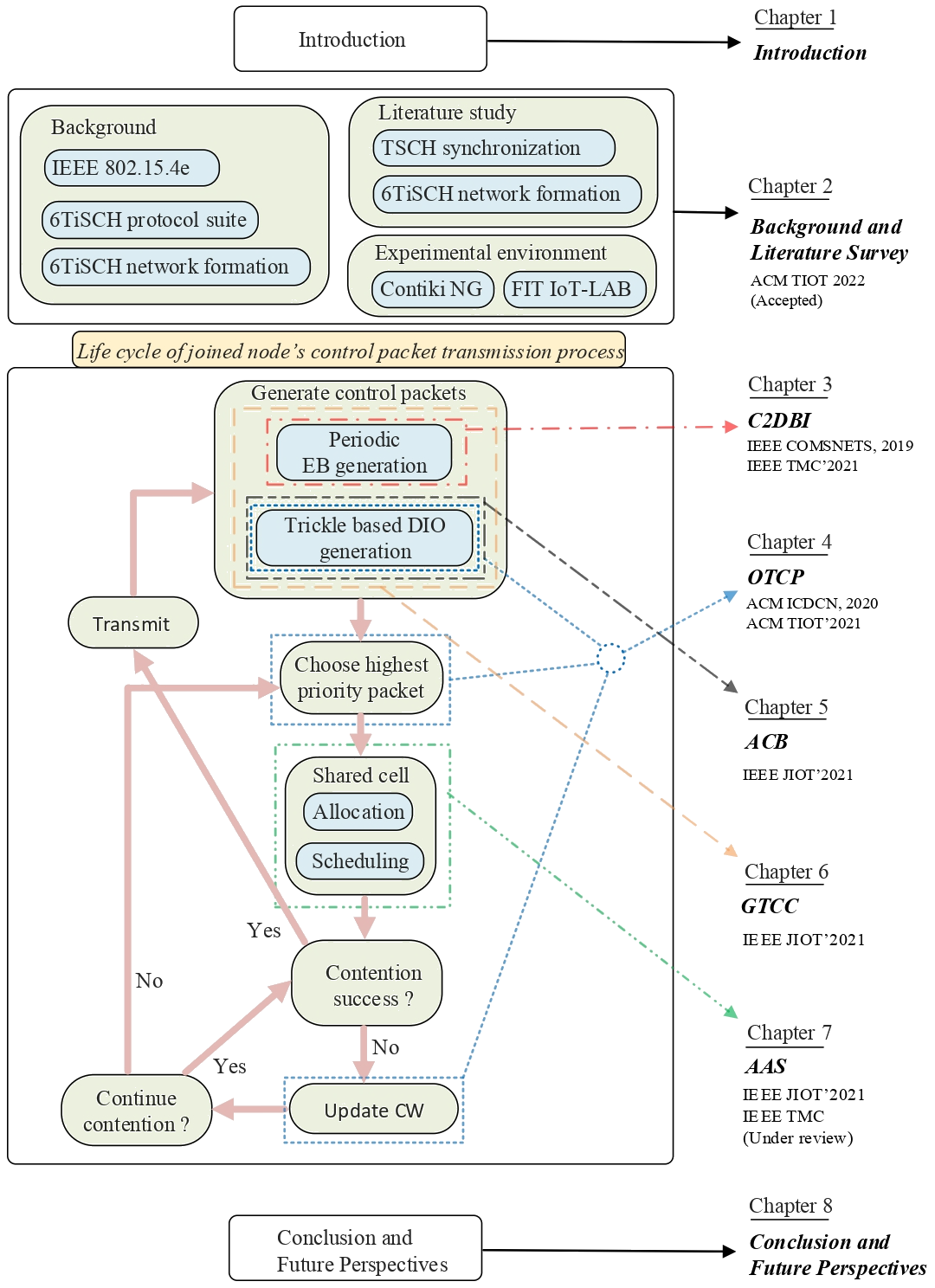
The IPv6 over the TSCH mode of IEEE 802.15.4e (6TiSCH) network is standardized to meet high reliability, end-to-end latency, and network lifetime requirements of various IoT applications. The formation of 6TiSCH network should happen before establishing end-to-end data communication. So, the 6TiSCH Working Group published 6TiSCH Minimal Configuration (6TiSCH-MC) standard for 6TiSCH network formation. Basically, 6TiSCH network formation is started by the Join Registrar/Coordinator (JRC), and all the new nodes (aka pledges) join one-by-one in the multi-hop 6TiSCH networks. Faster formation of 6TiSCH network is challenging because of the inherent channel hopping feature of TSCH as the pledges do not know in which channel and at what time control packets are transmitted by the already joined nodes and/or the JRC. Apart from this, the resource allocated by 6TiSCH-MC standard is static in nature, and it did not provide any mechanism to handle congestion in shared cell and to regulate the transmission rates of different control packets used to form the network. Therefore, we set the objective of this thesis is to augment the 6TiSCH-MC standard by updated mechanisms for achieving faster formation of 6TiSCH IoT network. It is observed that congestion in shared cell becomes an inevitable problem when the number of joined nodes increases, and it degrades the performance of 6TiSCH network formation. Therefore, to reduce the congestion in shared cell, we proposed two schemes, namely, channel condition based dynamic beacon interval (C2DBI) and game theory based congestion control (GTCC). We further observe that due to fixed priority assignment to the control packets and insufficient transmission of routing control packet, formation of 6TiSCH network gets delayed. Therefore, for sufficient and efficient transmission of routing control packet, we propose another two schemes, namely, opportunistic transmission of control packets (OTCP) and adaptive control packet broadcasting (ACB). Further, we leverage all the available channels at a time in order to increase the number of shared cells per slotframe for quicker transmission of control packets. For this, we propose another two schemes i.e., autonomous allocation and scheduling of minimal cell (TACTILE) and time-variant RGB (TRGB) model. Finally, it is worthwhile to mention that all the proposed schemes are evaluated by Markov Chain based theoretical analysis, simulation, and testbed experiments. As a whole, this dissertation improves the performance of 6TiSCH network during its formation period in terms of joining time and energy consumption of the IoT nodes while maintaining stable network
    @phdthesis{Alakesh_Thesis,
    title={Adaptive Resource Allocation for Faster Formation of 6TiSCH IoT Network},
    author={Kalita, Alakesh},
    copyright={university},
    year={2022},
    school={Indian Institute of Technology Guwahati},
    language={English},
    urldate={2024-04-28},
    url={http://hdl.handle.net/10603/437588}}
Technical Reports
- A. Kalita, “Contiki-NG, CC2650 IoT devices, and FIT IoT-LAB.” PDF
Preprint
- arXiv A. Kalita, ``Large Language Models (LLMs) for Semantic Communication in Edge-based IoT Networks''. PDF
- arXiv P. Joshi, A. Kalita, M. Gurusamy, ``Reliable and Efficient Data Collection in UAV-based IoT Networks''. PDF
- TechRxiv A. Kalita and M. Gurusamy, ``D2R2: Distributed and Dynamic Reputation based Resource Allocation in Metaverse''. PDF
Patents
- Indian Patent A. Kalita, ``A System and Method for Improving the Performance of IEEE 802.15.4 and IEEE 802.15.4e standardized Internet of Things Networks''. [Filed on 28/03/2025; Ref No: 202531029706]
- Indian Patent A. Kalita, ``An Internet of Things (IoT) enabled System and Process for real-time Monitoring of an Infant to Prevent Falling Off a Surface above Ground level''. [Filed on 24/10/2024; Ref No: 202431081152]
Book Chapter
- Springer A. Hazra, P. Maurya, A. Kalita, I. Sarkar, ``Offloading Strategies and Computing Paradigms in IoT: A Survey", in book ``IoT Sensors, ML, AI and XAI: Empowering A Smarter World. Smart Sensors, Measurement and Instrumentation'', vol 50. Springer. Link